6 Tips to improve your Pronunciation of French Sounds
(French Phonetics)
For beginners or non-beginners

« French Pronunciation » can be divided in 2 parts
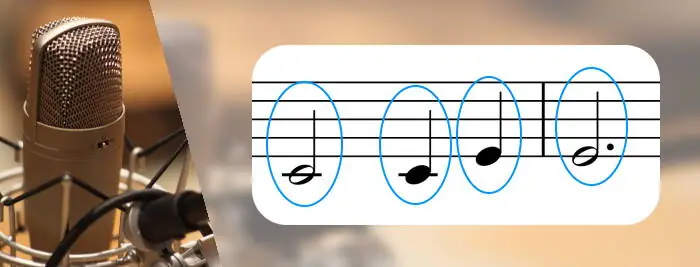
How to pronounce French sounds (Phonetics) is like learning Musical Notes
How to pronounce French Sentences is like Playing Music : how you play theses sounds together
If you compare French pronunciation to music :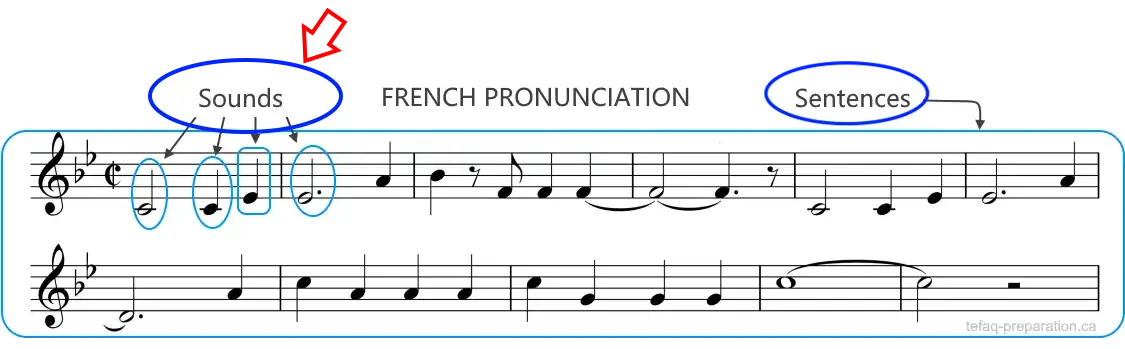
Find below explanation on part #1 :
« How to pronounce French Sounds (Phonetics) ? »
Pronunciation of French Sounds
Why mastering « Pronunciation of French Sounds (Phonetics) » is important ?
Mastering « Pronunciation of French Sounds » and tonic stress will :
Help your interlocutor to understand your message
Enrich your message

Here are the 6 Tips to improve your Pronunciation of French Sounds :
(With examples and audios)
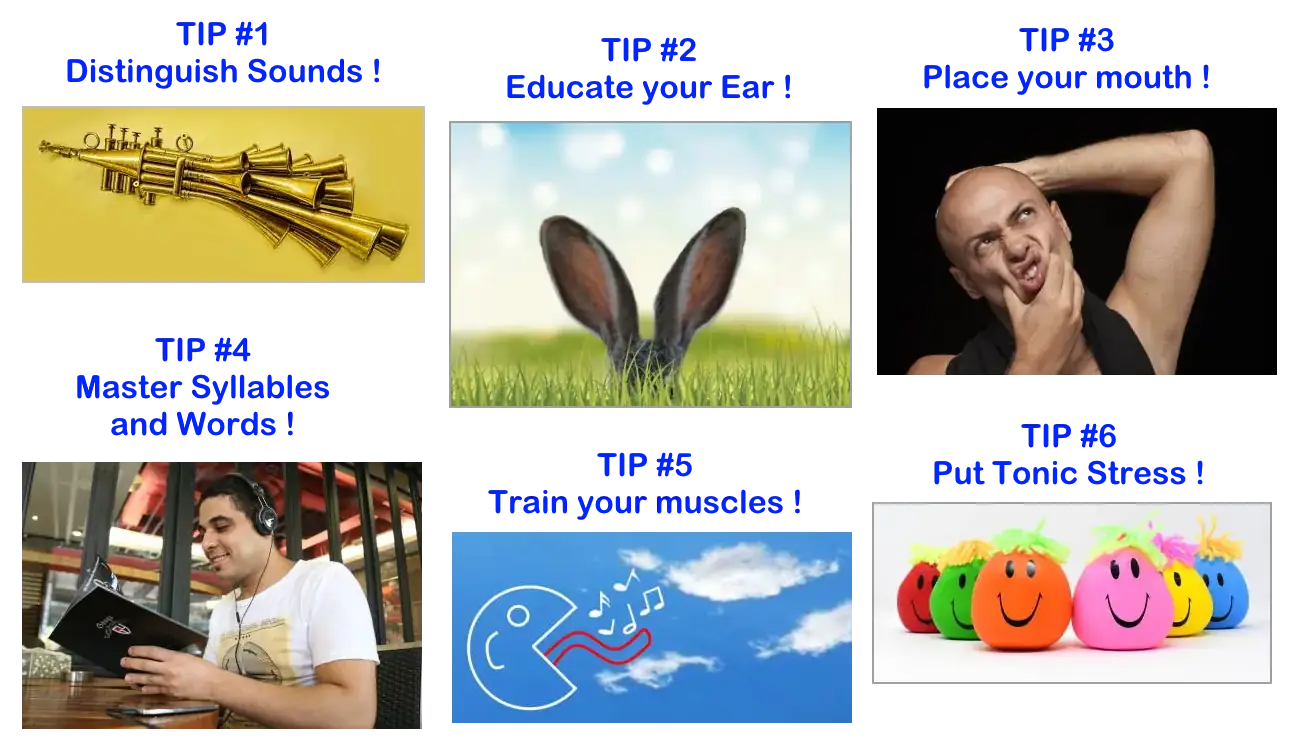
TIP #1 :
Keep in mind that if you are unable to well identify or distinguish a French Sound, you cannot know whether you are pronouncing it correctly.

French Phonetics has 36 French sounds (and French alphabet has 26 letters).
TIP #2 :
If you struggle with pronunciation of French Sounds:
Educate your ear and focus on your difficulties. After you will make progress faster
TIP #2bis :
If you don’t struggle with pronunciation of French Sounds, if you like the idea, and if you’ve some spare time :
Check that your ear can clearly distinguish the 36 sounds of the French language, because I am almost certain that you will identify unexpected difficulties or minor weaknesses. Then improve yourself, and… it will be for life!

Here are some examples of micro-challenges for students:
- Distinguishing between “B,” “P,” and “V” when they do not exist in the same way in your native language.The same applies to the pronunciation of “U” and “OU” :
- J’ai bu <=> J’ai pu <=> J’ai vu
- Tu <-> Tout
- Tu as tout bu <=> Tu as tout vu
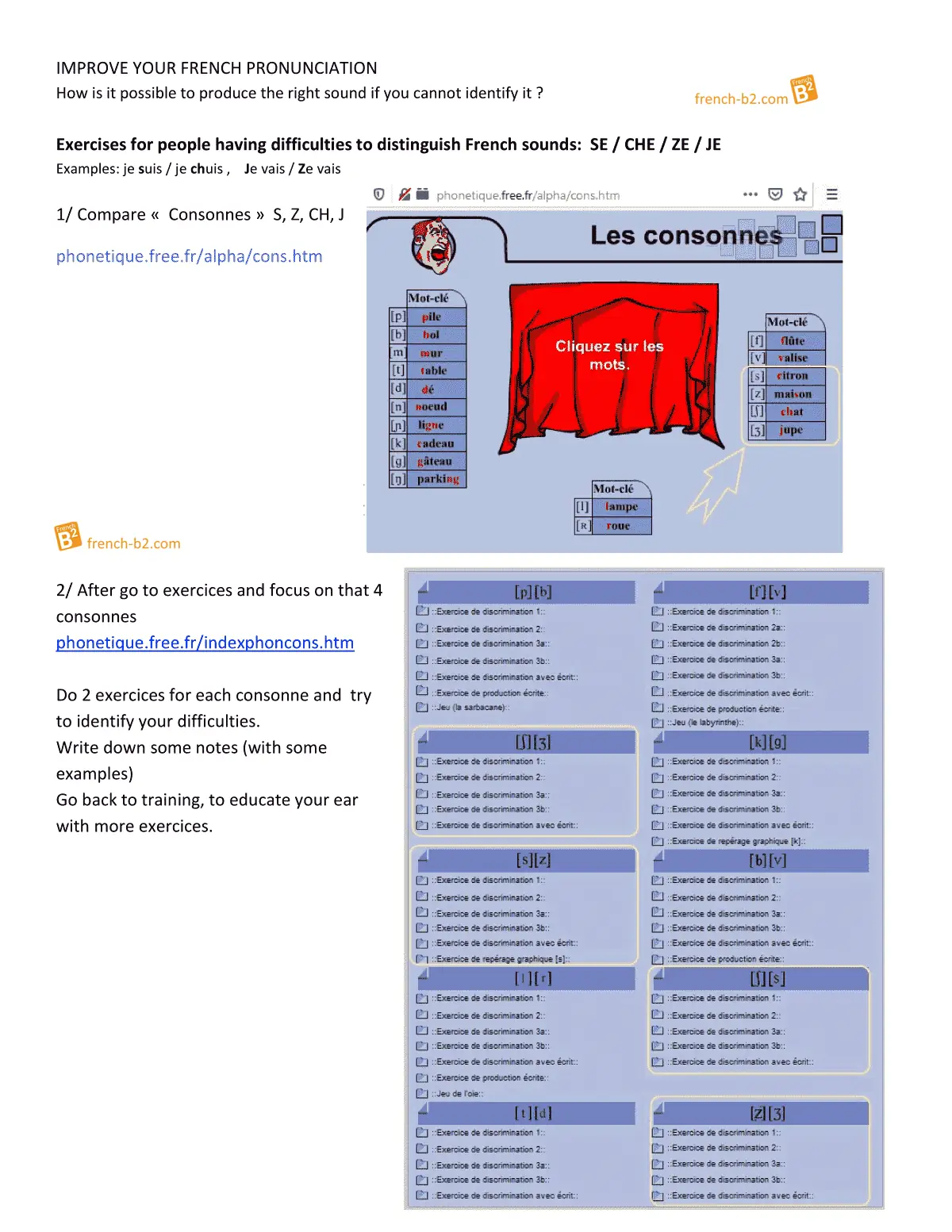
- For other native languages, it could be to distinguish the difference between “S” and “CH” or « J » and « Z«
- Je suis <=> Je chuis
- Je vais <=> Ze vais
How to educate your ear and to improve your pronunciation ?
The modern solutions :
There are several websites where you can find many well-documented exercises.
Such as :
A lightweight-old solution for training your ear (effective, but not “mobile”)
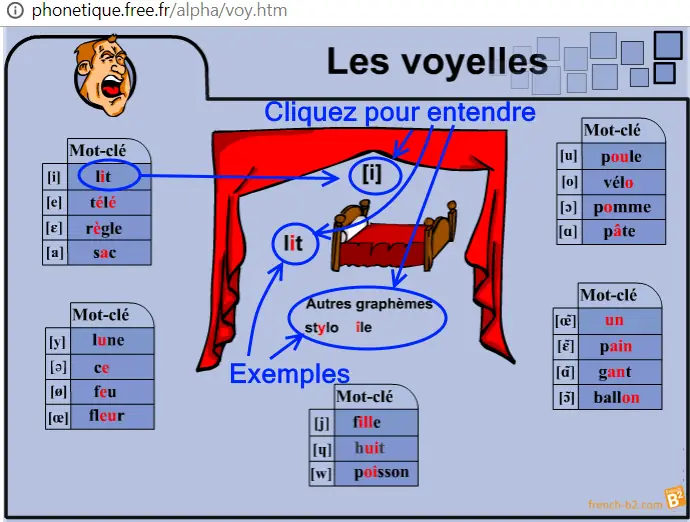
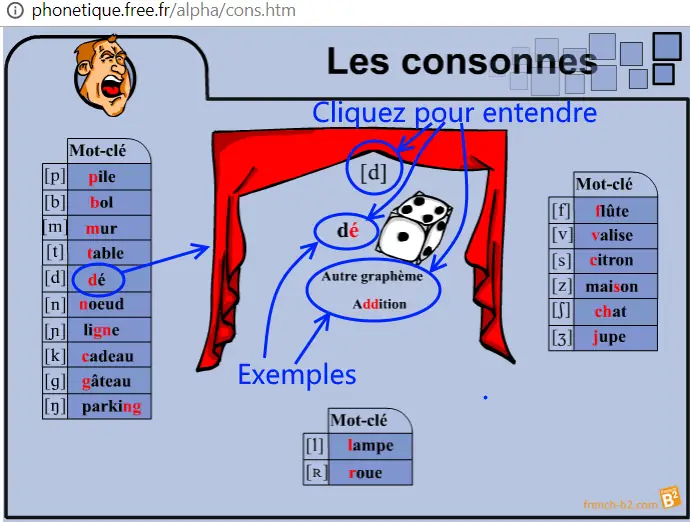
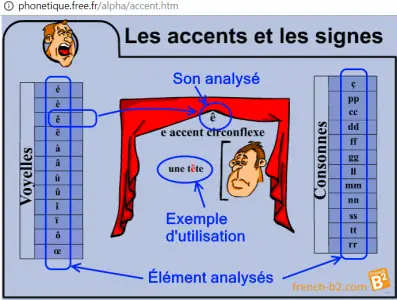
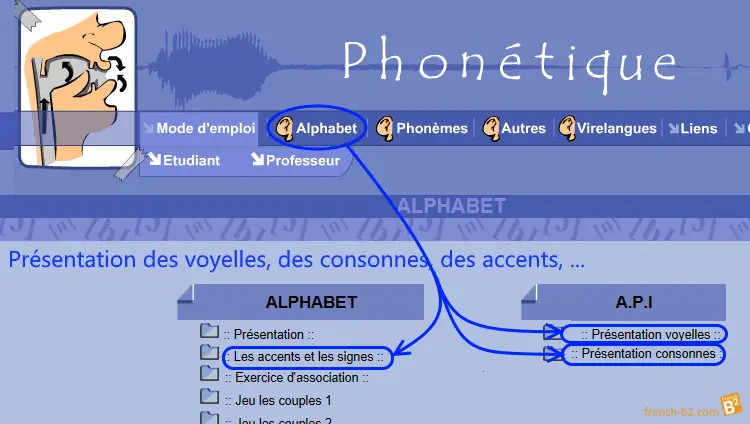
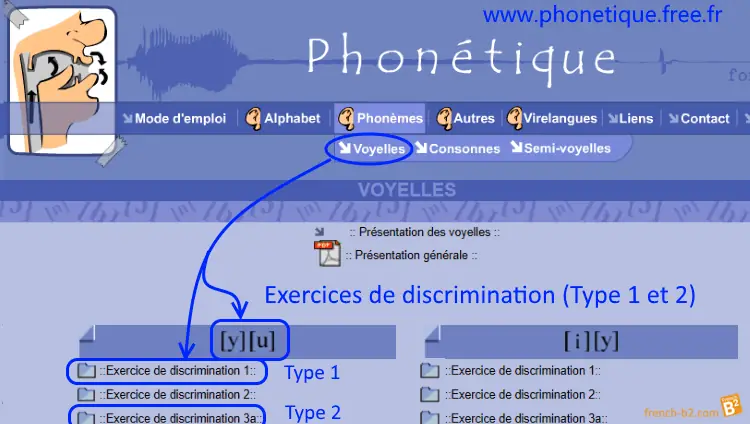
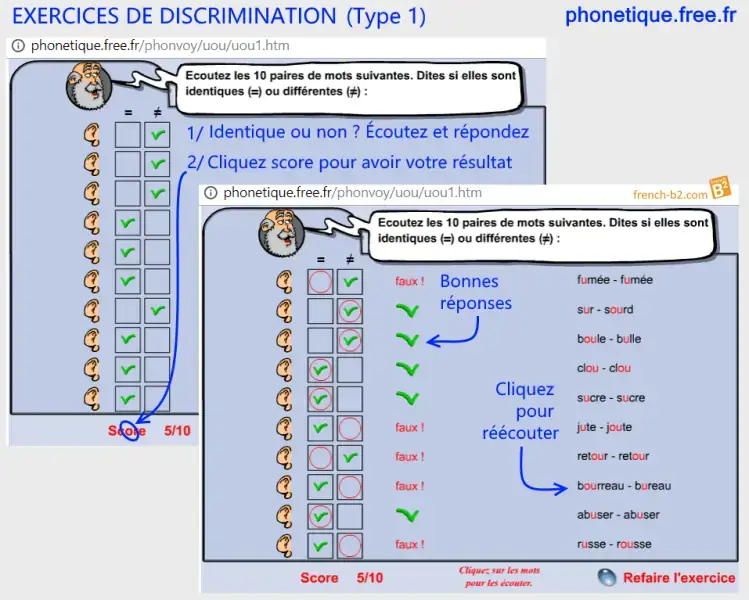
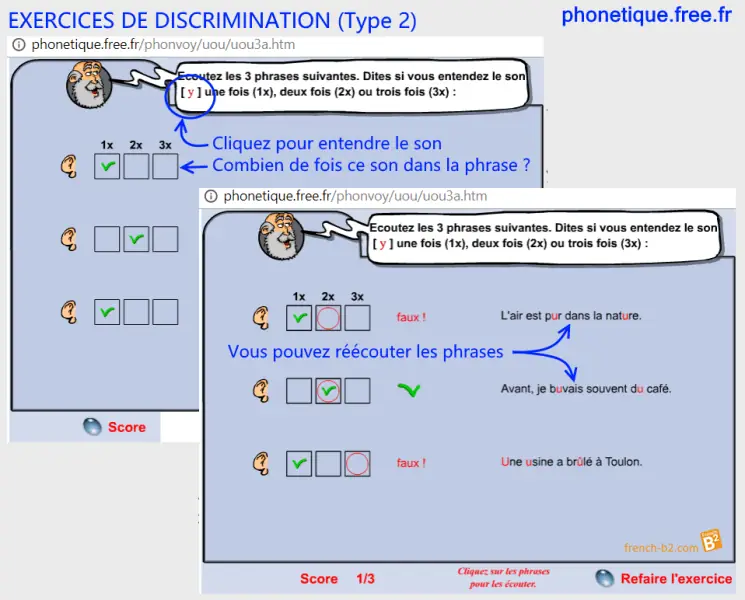
If you want to go faster, I would recommend to start with a small website, well structured, which does really good job to educate your ear in a short time. Big advantage is the clear-quick feedback on your exercises (See pictures below)
I hope this website would be still online a long time.
Name of the website : phonetique.free.fr
It is not a « mobile solution »
The user interface is outdated but effective, needs some updates, and requires a Flash player for your browser.
You will need to spend 10 minutes to understand how it works. After that, everything runs smoothly.
Students use a secure, open-source Flash-player add-on named RUFFLE
Examples of exercises you can do on this website :
TIP #3 :
Place mouth the right way to produce the right sounds
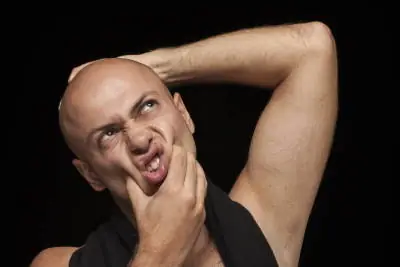
The mouth is a musical instrument, and the shape of this instrument must be modified to produce the desired sound: the position of the lips and tongue, the opening of the mouth, the passage of air (nasal), etc.
If you position your mouth incorrectly, your pronunciation will be unclear (or perhaps almost clear when speaking softly, but probably very different when speaking loudly), and your message is likely to be misinterpreted.
To gain confidence, learn how to position your mouth correctly and practice until it becomes second nature.
How to place your mouth
Watching videos can be very helpful in correcting difficulties. Asking a native French speaker for help is also a good solution. You can also practice in front of a mirror (or film yourself with a phone) to observe the position of your mouth and improve it.
A website with animations :

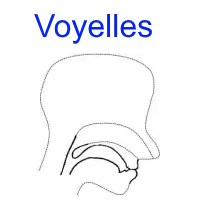
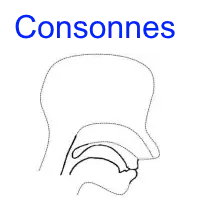
Invert the process : from a mouth position find a sound :
Try it once and take it seriously, just to know if you are able to imagine the sounds and to have a different overview 😎
TIP #4 :
Master pronunciation of syllables and words

Since there is a big difference between the decoding of a written message and an oral one, to go faster, know well :
- « les liaisons »,
- « les accents »,
- Silent letters : « E », « H »
- Know the simplifications / omissions in colloquial French
Find more explanations and links in mini-tips
Review : Silent letters « E » and « H », « Élisions », and « Liaisons »
- Introduction to French Pronunciation (Sounds, Silent letters “E” and “H”, “Élisions”, and “Liaisons”)
- Pronunciation of French “H”
More about “Les liaisons” :
In French :
Some exercises on “les liaisons”
Read with a French native speaker to have a feedback
or
Read alone (while recording), and I suggest this method whan you have audios with transcripts :
- Analyze the text, imagine “les liaisons” and underline
- Read the text while recording yourself
- Listen to the audio
- Compare the audio with your recording and identify your difficulties
- Read again aloud while listening to the audio
TIP #5 :
Train your muscles and over-articulate

Do exercises to train your muscles.
Practice pronouncing tongue twisters and you will be surprised at your progress.
- To place youth mouth correctly
- To train muscles (and not to be quickly tired )
- To get automatism
- To keep it naturally after a while
Kids, adults, actors, VIP, … practice Tongue Twisters in any country, any language to get a clear pronunciation.
Examples of tongue twisters online
Here are some examples of tongue twisters : 
How to practice:
- Speak loudly and begin by slowly pronouncing a tongue twister, exaggerating the movements of your mouth (exaggerated articulation)
- Then, speak at a normal speed and continue to exaggerate your pronunciation.
- Then you go faster and always exaggerate the pronunciation.
- If you practice for 10 minutes a day (or for a few weeks for some difficult tongue twisters), the results will be excellent: you will have good pronunciation with almost natural movements.
- You can also practice with friends and organize a game: who can speak the fastest while maintaining good pronunciation? Laughter guaranteed!
😎A tip: during your first workout, record yourself with your phone so you can see your progress after a few days. You’ll love the results!
A tongue twister can be difficult at first. Here is some actions you can do :
- Work in front of a mirror and watch the movements of your mouth when you speak well and when you say badly.
- Do not forget to move your jaw, to exaggerate movements.
- Watch mouth movements on online videos
- Check how you place your tongue, your lips, your jaw, …
- Forget your apprehension (to feel like “stupid” or “funny”) because it’s a real winner. Don’t hesitate to open your jaws and to exaggerate movements
- There is not enough exaggeration if you don’t feel that your muscles are working
- Ask the help of a francophone or a teacher to correct you
TIP #6 :
For a word alone : Put Tonic Stress on last pronounced syllable

In French, for a word alone, put Tonic Stress on last pronounced syllable.
Meaning is : on the stressed syllable, put more intensity and a slightly longer pronunciation.
- More intensity on last syllab : restaurant / restaurant
- What is a longer pronunciation ? restaurant / restaur a n t
- More words : voiture, tablette, téléphone, cinéma, j’adore, j’étudie, restaurant
- Same words with an article or a pronom : une voiture, une tablette, un téléphone, un cinéma, j’adore, j’étudie, un restaurant
This is where the tonic accent is put when pronouncing a word alone, in a sentence, it’s different (See : HERE)
To sum-up, 6 mains tips for Prononcing Sounds :
- Know the 36 basic sounds of the French language
- Educate your ear
- Place mouth the right way
- Master pronunciation of syllables and words
- Train your muscles and over-articulate
- For a word : Put Tonic Stress on last syllable
- Also check « How to improve your « Intonation » and « Tonic stress » in a sentence »: HERE
French Sentences Pronunciation / Intonation and Accentuation