3 Tips to improve your Pronunciation of French Sentences
by using « Rythmic Groups », « Intonation », and « Tonic stress »
French pronunciation has rules that must be followed in order to communicate effectively.😇
For beginners and non-beginners to enrich your message !

« French Pronunciation » can be divided in 2 parts
How to pronounce French sounds (Phonetics) is like learning Musical Notes
How to pronounce French Sentences is like Playing Music : how you play theses sounds together
If you compare French pronunciation to music :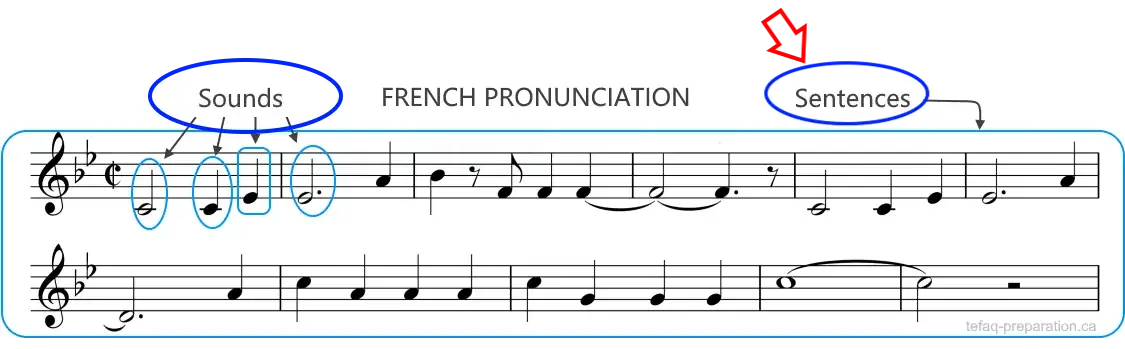
Find below explanation on part #2 :
« How to pronounce French Sentences ? »
Pronunciation of French Sentences
Why mastering « Pronunciation of French sentences » is important ?
Mastering « Pronunciation of French Sentences », using intonation, emphasis stress, and rhythmic groups will :
- Help your interlocutor to decode your message
(= Kind of rules, giving an organization-structure of sentences) - Give the desired meaning to your message
(You will enrich your message) - Help you to get a kind of feeling of the language structure, to organize your message

Here are the 3 TIPS, with examples and audios.
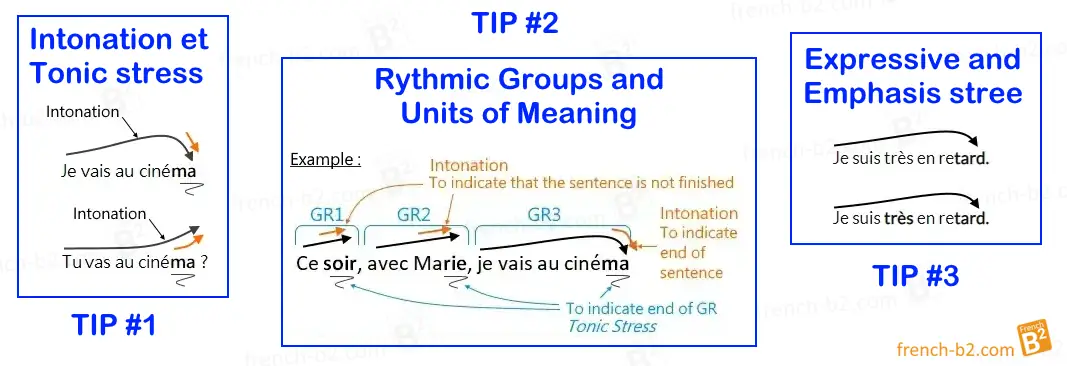
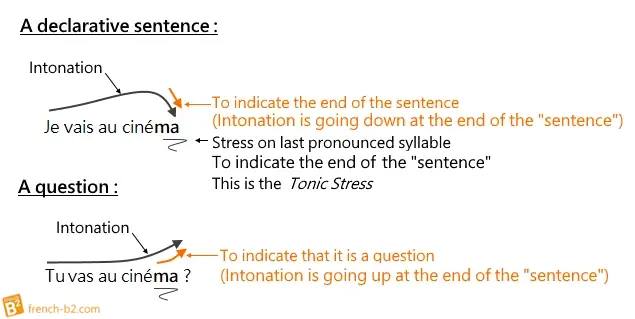
1/ Intonation and Tonic Stress help your interlocutor to decode your message
A short example :
- If going down at the end of the « sentence » => your interlocutor understand : End of « sentence »
- If going up at the end of the « sentence » => your interlocutor understand : Question
2/ Rhythmic Groups as Units of Meaning to help your interlocutor
Because a sentence can contain a lot of information, to help your interlocutor, the information is divided into « Units of meaning ». (Note : « Unit of Meaning » = « Rhythmic Groups » = « Groupes Rythmiques » = GR )
The « target » is to help your interlocutor to catch Units of Meanings (= Rhythmic Groups), and for that, he must be able to :
- to identify the beginning and end of the « Units of Meanings » (GR)
- to know if it is a question, a declarative information, …
- to identify the end of the sentence (End of last « Units of Meanings »)
Intonation and Tonic Stress follow simple rules :
- To indicate the end of GR : Stress on the last pronounced syllable (called : Tonic Stress)
- To indicate that another GR follows : the intonation of GR does not decrease at the end of GR
- To indicate the end of the sentence (No GR follows) : the intonation decreases at the end of the last GR
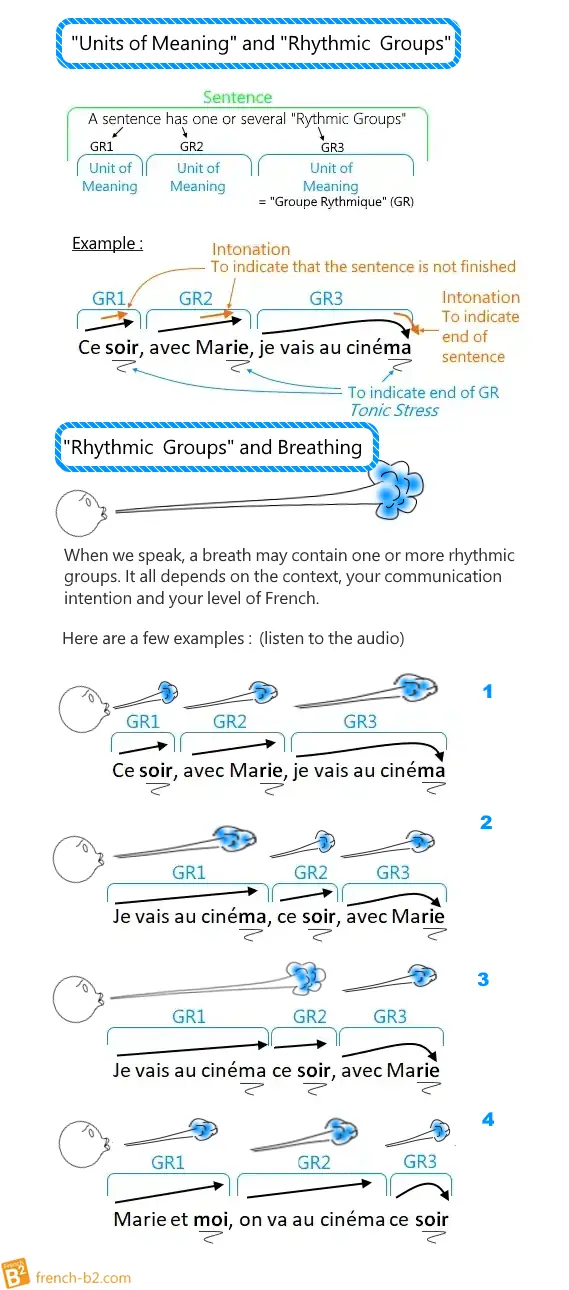
- If you are a beginner, start like in #1, #2, and #4, and slice your sentence. It is the first step in managing intonation and stress.
When ready do like in #3 and put several Rhythmic Groups (Units of meaning) in the same breath, still in control of intonation and stress.
Listen to audio :
More information about Rhythmic Groups as Units of Meaning :
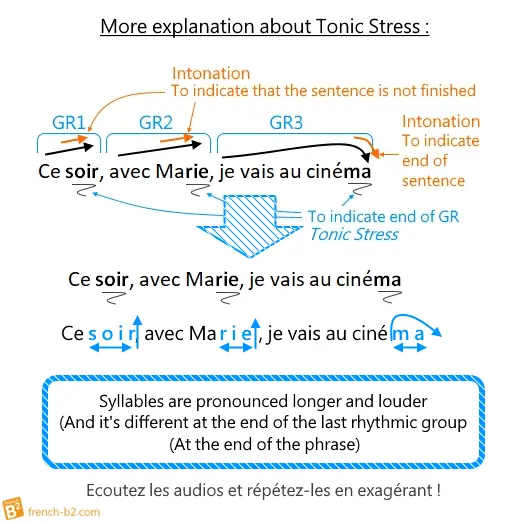
These 4 sentences are simple school cases to explain the concept and there are commas between the « Rhythmic Groups » and connectors.
In a real conversation, when you speak, there is no written comma and you decide how to divide your message into rhythmic groups (Groups of meaning).
In fact, a breath includes one or more rhythmic groups, and a breath with a single rhythmic group is easier to pronounce, and it’s easier to manage the intonation and accentuation you want. Adapt the number of rhythmic groups per breath according to your level and the level of your interlocutor, taking into account the context of the conversation..
3/ Expressive and Emphasis Stress
- Intonation and Tonic Stress help your interlocutor to get Units of Meaning (Rhythmic Groups).
- The next step is to enrich Units of Meaning, to give a feeling, or emotions, to enrich your message with Expressive Stress / Emphasis Stress :
- Emphasis Stress is used to insist, to increase the meaning of a word …
- Expressive Stress is used to express feelings or emotions
Emphasis and Expressive stress are a combination of stronger and longer pronunciation of one or several syllables (Strenght and length depend on your communication intention). Example: C’est très bien ! C’est trèès bien !
Emphasis Stress
To insist, to increase the meaning of a word : 3 examples
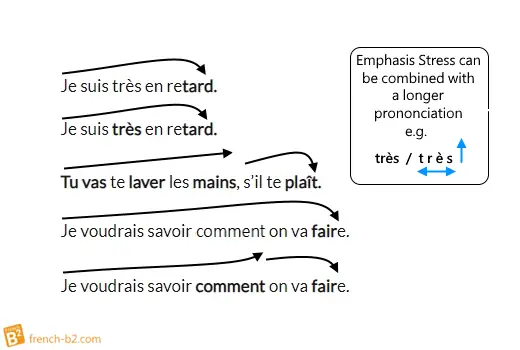
Expressive Stress
To express feelings or emotions : 3 examples :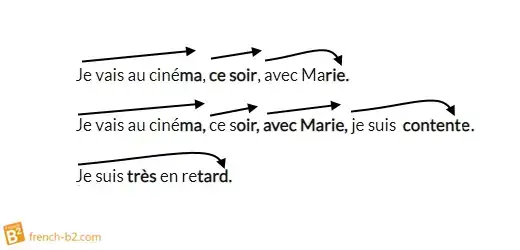
Listen to audio.
The speaker wants to emphasize a word, an expression such as : Très, avec Marie, ce soir, contente. This is to enrich your message and grammar doesn’t decide anything here, you decide your message, how you want to put it, what you want to say.
Another example :
- You are afraid (neutral) : « J’ai peur »
- You are afraid (with a feeling) : « J’ai peur » +, » J’ai très peur « ++